
Decoding the Digital Engine: How Modern Search Engines Work (And How Marketers Must Adapt
Search engines were essentially just digital phone books in the early days of the internet.You would almost certainly be at the top of search results if you used a phrase like “best shoes” twenty times on a webpage.In the present day, search engines have evolved into complex contextual networks powered by AI.They measure user intent, comprehend context, and assess each site’s legitimacy in addition to reading words.
It is now essential for brand managers and business owners to comprehend search engine mechanics. It serves as the cornerstone of online visibility. Our objective as digital marketers is to match our tactics with how search engines find, assess, and provide value to actual users—not to “hack” these algorithms. Here’s a behind-the-scenes look at how search engines work and how to position your brand to rule the contemporary Search Engine Results Page (SERP)
The Core Process: How Search Engines Think
A search engine goes through three separate processes in the background before displaying a list of results: crawling, indexing, and ranking
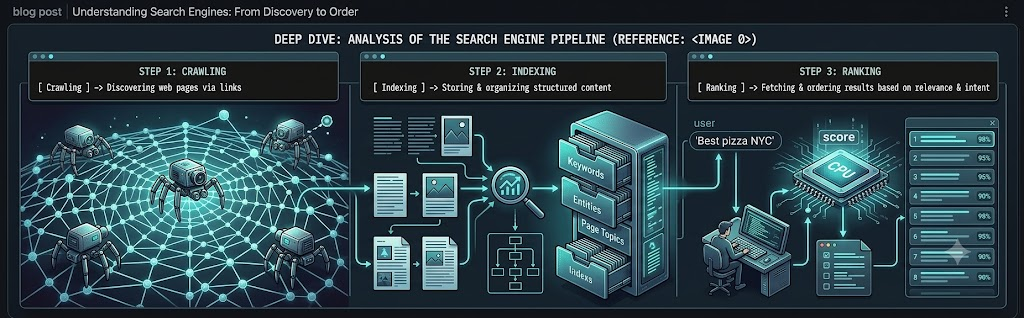
1 Crawling: Finding the Content
A search engine employs bots, which can be called “crawlers” or “spiders.” It is an automated software that searches the Web for new and updated content.
The crawler starts its work from a list of known web addresses and follows the links that it encounters along the way. The crawler may not find some important web pages because there is no structure on your website.
2 Indexing: Organizing the Digital Library
After a spider finds a web page, the search engine then begins to process and analyze the content of the page; this includes the text, the images, the video, and the coding structure of the web page.
The Index can be likened to a large worldwide database for libraries. The search engine will index the page and classify it based on the subject matter and other structural tags.
3 Ranking: Delivering the Best Answer
After the query is entered into the search bar by the user, the engine searches through its extensive multi-petabyte database to bring out the most relevant results.
The process that helps determine which results will be listed at the top involves considering hundreds of ranking factors in just a few milliseconds. Such factors include keyword relevancy, technical soundness, user experience, and geolocation.
The Evolution of Search: Keywords vs. Entities
The major revolution in modern search is not speed but comprehension.
In the past, search engines worked via lexical matching (where words inputted by the user match words on a website). But in today’s search, search engines are able to do semantic search thanks to NLP and vector embeddings.
# In the Past: Text was considered a sequence of string characters: “Apple” = 5 letters
# In the Present: Search engines understand real-world entities and their relationships; they can determine what “Apple” means (fruit, technology company, or record label) depending on context.
For content marketers, this implies that there is no such thing as “keyword stuffing” anymore. You can’t repeat a primary keyword endlessly – instead, you have to satisfy Search Intent.
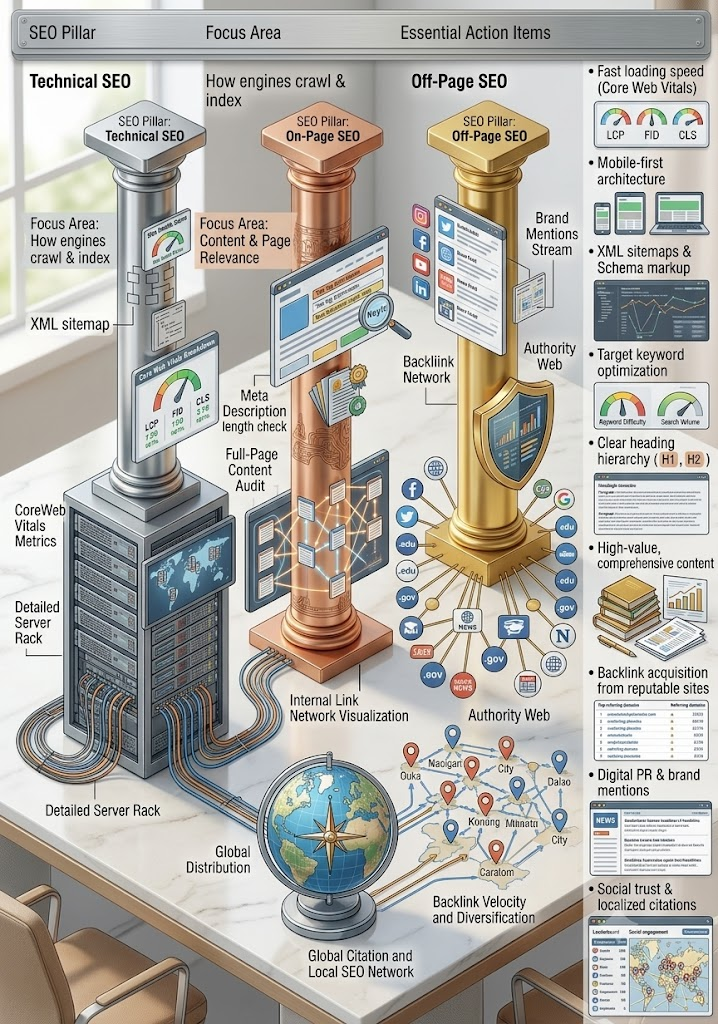
The Three Pillars of Search Engine Optimization (SEO)
Digital marketers organize their work around three key disciplines to create a website that search engines love to rank.
Organic Search vs. Paid Search (SEM)
An optimized digital marketing approach uses both parts of the search engine results page: Search Engine Optimization (SEO) and Search Engine Marketing (SEM/Paid ads).
Organic Search (SEO) refers to gaining exposure through valuable content and proper optimization. It requires time investment and patience but gives long-term sustainable returns on investment (ROI) without having to pay per click.
Paid Search (SEM) refers to bidding on valuable keywords using Google Ads and other similar platforms in order to be able to appear at the top of the results. It offers instant exposure and conversion tracking and ends once the daily budget is depleted.
Together, SEO and SEM provide the best possible results.
Key Trends Shaping the Future of Search
Search engines have become more advanced than ever before. For us marketers, we need to keep up-to-date with the latest search engine changes. 1 AI-Driven Search Experiences: Search engines have begun to synthesize content from the results pages through AI overview summaries. The way forward for optimizing for visibility is by offering concise expert answers that can be cited as sources 2 E-E-A-T (Experience, Expertise, Authoritativeness, and Trustworthiness): Human experts with firsthand experience are now rewarded with top-ranking positions by the search engines. Non-expert opinion-based content created through fluffy language is now being penalized. 3 User Experience & Engagement (SXO): Search Engine Experience Optimization is a combination of Search Engine Optimization and User Experience (UX). This includes fast load times, good navigational structure, and high user engagement (low bounce rates)
Final Thoughts: Building a Search-First Strategy
Essentially, the sole aim of any search engine is to provide you with the most accurate information as quickly as possible.
When you rely only on trying to satisfy an algorithm with your digital marketing, you’ll always be one update away from your rankings. However, when you develop intuitive experiences that are filled with expertise, you naturally align with the needs of the algorithm.
Search engines do not appreciate shortcuts. They value relevance, clarity, and authority.