
The search engine determines who appears. As a solo digital marketer, that choice affects your pricing, clientele, and comfort level.
As a digital marketing freelancer, you may have received a request like this many times before: “Our traffic fell through the floor yesterday. Did anything change on Google’s side?” It always comes early on a Monday when you are having your first cup of coffee for the week.
And the truthful answer will be yes. Google makes changes to its search algorithm several thousand times per year. The small ones are nothing special, but the major changes, such as helpful content updates or core updates, will re-rank the entire industry in a matter of hours. And this is how the volatility affects your business as a freelance marketer.
What the algorithm actually cares about
Google’s algorithm is a group of algorithms that attempt to answer one specific question: which page best fulfills the searcher’s query. Over time, the signals have changed from pure keyword density to things like
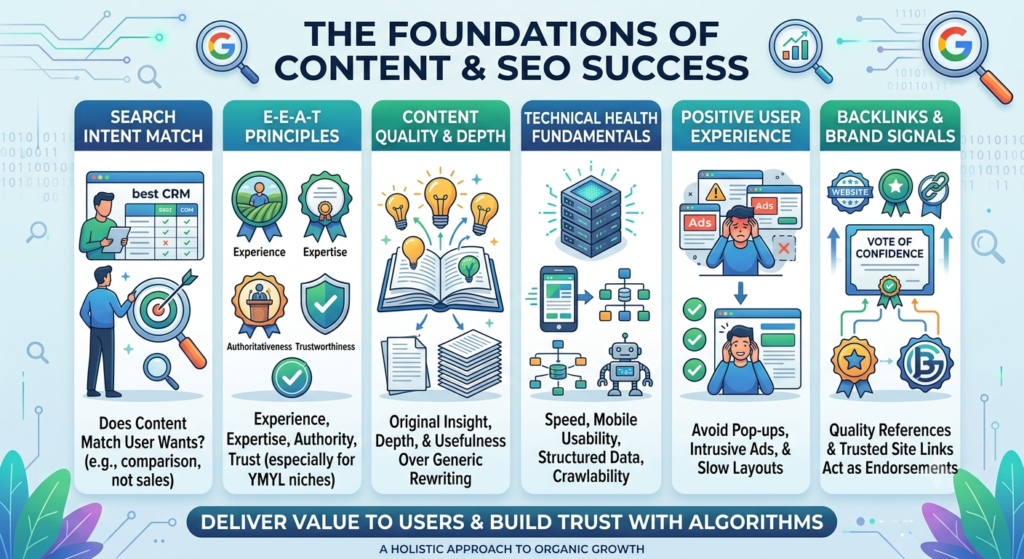
The concept of search intent describes whether the information available on your site is useful to your target audience, such as when “best CRM software” is used to conduct a comparison of products.
“Expertise,” “Experience,” “Authoritativeness,” and “Trustworthiness” are the four letters in the E-E-A-T acronym, and this acronym plays a significant role in fields such as healthcare, finance, and law.
Quality content is crucial because new content will always be more relevant than old or repeated content.
SEO can also include technical SEO, which is made up of aspects such as the performance of the site, mobile-friendliness, structured data, and search engine crawling of a website.
User experience is another important element.
Issues such as blocked content, load time, and numerous popups may affect the ranking of your website in the search engine.
Backlinks and brand signals remain important SEO elements.
How algorithm changes hit freelancers hardest
Clients do not always see algorithm updates as industry-wide events. They see them as something you, the freelancer, should have predicted and prevented. Here is how that pressure shows up in real life.
1. Results become harder to guarantee
What works in six months can stop working overnight. Rankings change, graphs resemble heartbeats, and customers start questioning you. Soon enough, you learn not to promise “page one in 30 days” but to promise process, metrics, and adaptability.
2. The work gets broader
The practice of SEO has changed compared to the way it was practiced before. Apart from being knowledgeable about how to work with keywords and meta tags, one should have a good understanding of content marketing, CRO, site speed, analytics, and even brand PR at times.
3. Budgets get questioned
As traffic wanes, the first item on the agenda is usually cutting your content retainers. This requires you to spend more time justifying the bigger picture and emphasizing the benefits of brand building while showing how the channel works.
4. You have to keep learning
SEO techniques have become the most temporary compared to anything before. The methods that were considered revolutionary even two years back, like the use of exact match anchor text, keyword stuffing, and private blog networks, may do more harm than good for your site right now. Freelancers who ignore new information will become obsolete.
What’s new in Google’s algorithm in 2026
If you have not done any SEO work for two years, then in 2026, SEO will be a totally new profession to you. What has changed fundamentally is the search engine. Search engines have become an answer layer with links attached to them rather than the old-fashioned ten blue links.
-AI answers own the page header—AI Overviews and AI Mode now perform a massive number of informational searches. There are many search queries where no click happens; thus, the performance metric that matters to freelancers now is visibility and assisted conversions, not sessions.
-Getting cited is as important as ranking—to get quoted in an AI answer, you need to write quality, factual, and well-structured content: concise answers at the beginning of the article; clear headings; tables; schema; and verifiable sources.
-Core updates come less often and are larger—Google tends to do continuous quality updates with some big reranks. Recoveries from updates now take longer, so rushing to rewrite your website after a two-week dip was a bad decision.
-Sponsored mass-produced content gets filtered more effectively—mass-produced sponsored content, parasitic SEO practices on leased domains, and expired-domain techniques were all targeted by Google recently. Quantity beats quality no longer.
-Real-life experience counts—original pictures, firsthand tests, verifiable credentials of authors, and reviews beat research summaries.
-Branding and entity signals become more important—search demand for brands, mentions on credible websites, and entity existence are very important for survival through update waves that kill anonymous publications.
-Search becomes multimodal and conversational—voice search, image search, and other searches become multimodal search and therefore require from searchers to form whole sentences while searching. The content answering long-tail questions works better than keyword-oriented content.
What the freelancer should do in practice by 2026: adjust expectations concerning impressions, brand signals, and earnings, not traffic, and measure where the client appears in AI answers. The clients that get the idea of the new scoreboard stop freaking out just because of clicks.
What has worked for me as a freelancer
I do not claim to have a crystal ball, but here are a few habits that have kept my clients stable through algorithm storms:
-Use questions from Search Console, interviews, and support tickets to create content based on actual questions.
-Master the technical essentials—A pretty blog is useless if it takes five seconds to load and is not indexed.
-Sourcing traffic from multiple channels—email, social media, paid traffic, and community traffic—will lessen your reliance on one channel.
-Document every step—When things change in terms of ranking, clients feel more confident in you when you can prove how things have changed and what you are doing to address them.
-Be up front about limitations—sometimes the rankings are not because of anything you did. Honest communication goes further than false bravado.
The opportunity within the chaos
This is the good news: every update to the algorithm makes shortcuts less valuable and sustainable marketing more valuable. This is exactly what a good freelancer should be offering. If you are concentrating on content that really helps, proper foundations, and responsible promotion, you are already on the right track that Google is moving towards.
In the case of freelancers, the algorithm is not an enemy; it is an arbiter. It rewards those who do the tedious yet necessary work that the client would not pay for unless they got burnt earlier from some cheaper alternatives.
Final thought
You do not have any control over Google’s algorithm. You can only control your process, your client’s expectations, and how good a job you do. Those who make it through the next update will be the ones who are not obsessed with every trick possible for ranking but rather those who create websites and content that should rank in the first place.
The key to competitive advantage in the ever-changing search world is not wizardry, but rather trust, clarity, and consistency. This is what transforms one project into a consistent client relationship.
What is coming in 2027
As far as the forecast into 2027, the algorithm shows no signs of slowing down. If anything, the speed of change only appears to be speeding up, and those who get prepared now will have a much more relaxed year compared to those waiting for the next version of the algorithm to come out to react. Taking into account the current course of search, here’s what I’m watching for in 2027.
-The trend toward agentic search will extend to tasks—AI agents will go from answering questions to performing actions, such as product comparisons, service bookings, and research summaries on several pages. Freelancers will have to think about optimizing for action, since the search engines will take care of some of the steps in the customer journey.
-The importance of indexing in real time and personally increases—Google is going to give more weight to fresher signals and personal context. So, local, timely, and personalized content can outrank generic content that is older. This is an excellent opportunity for clients with physical locations and seasonal offerings.
-Thresholds for quality get higher—easy-to-produce AI-generated and low-effort, thin content will be suppressed even harder. Websites that don’t show any authorship, research, or expertise will have problems staying visible, particularly in your money and life areas.
-Video and visual searches are getting ranking signals—search engines can comprehend short videos, product demonstrations, and video explanations. Freelancers need to help their clients produce lightweight videos along with relevant metadata, not only text blogs.
-Trust indicators are public and credible, which is to say review sites, author credibility, and business listings are to be trusted more than hidden and deceptive social proofs, which are going to get a leg up in the competition.
-It becomes more difficult to attribute results, as the majority of searches are now taking place through AI assistants, chats, and voice interfaces; traditional click-throughs and analytics systems are going to underestimate the true impact that content is having. Freelancers will have to create new models for measuring assisted conversion, branding mentions, and share of voice in AI responses.
Freelancers should prepare for 2027 as a time when they become a strategic advisor rather than a traffic director for clients. They would be expected to describe how their client’s brands are presented in search, AI assistants’ responses, video, and voice search with appropriate metrics that take into account the fragmented environment. It is those freelancers who would prepare themselves now that clients will turn to when new updates come out.